What Is a Cloud Landing Zone — And Why You Need One Before You Scale

Moving to the cloud is deceptively easy.
You create an account, spin up a few services, deploy your first workload, and everything works. At least at first. The problems usually don’t appear when you’re experimenting — they show up when the platform starts to grow, when more people touch it, and when real business data and compliance requirements enter the picture.
This is the point where many teams realise they’ve been “using the cloud,” but not really operating in it. That’s where the idea of a Cloud Landing Zone becomes critical.
A Cloud Landing Zone is not a single resource or a checklist item. It’s the foundation that determines whether your cloud environment will remain manageable, secure, and scalable — or slowly turn into a fragile, expensive mess.
So, What Exactly Is a Cloud Landing Zone?
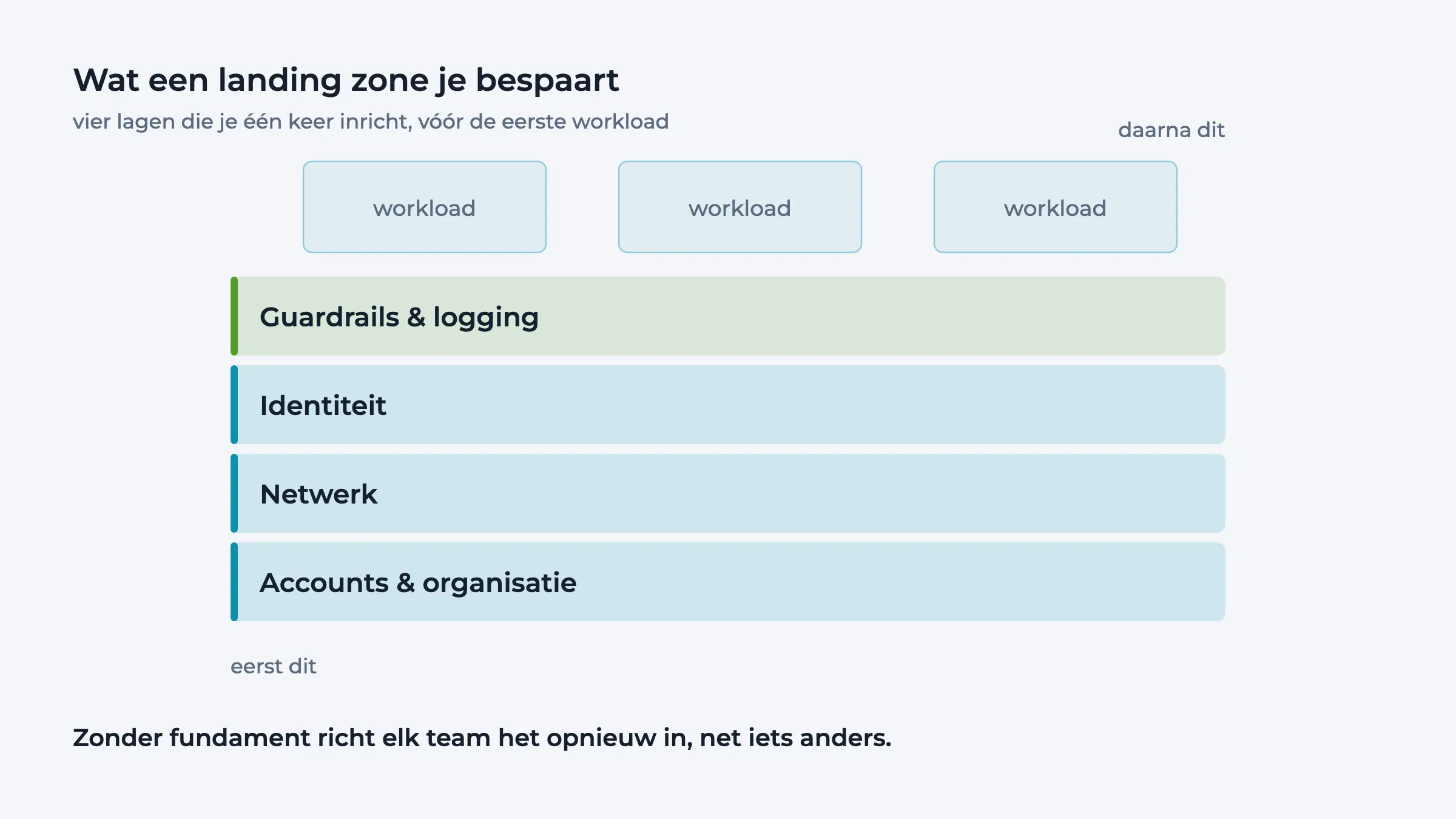
At its core, a Cloud Landing Zone is a predefined, repeatable cloud foundation that sets the rules for how everything else is built.
It defines how cloud accounts or projects are structured, how networking is laid out, how identities and permissions work, and how security and compliance are enforced. Instead of making these decisions ad hoc — one service or team at a time — a landing zone makes them explicit from the beginning.
You can think of it as the difference between building a city with zoning laws and infrastructure, versus letting every building connect its own power lines and roads.
Why Teams Get Into Trouble Without One
Many teams delay building a landing zone because they want to “move fast.” Ironically, this is often what slows them down later.
Without a clear foundation, patterns start to drift. Different environments behave differently. Access rights accumulate over time. Network boundaries become unclear. Logging and monitoring are inconsistent. Eventually, even small changes feel risky because no one is fully confident in how everything is wired together.
The most common problems we see in cloud environments without a landing zone are:
-
permission sprawl and unclear ownership
-
inconsistent dev, staging, and production setups
-
security gaps that only appear during audits or incidents
-
growing cloud costs with no clear attribution
-
slow onboarding of new developers and teams
None of these issues appear overnight. They emerge gradually — and by the time they’re obvious, fixing them is much harder.
What a Cloud Landing Zone Actually Provides
A well-designed Cloud Landing Zone doesn’t try to control every detail. Instead, it establishes guardrails that give teams freedom within safe boundaries.
At a high level, it usually covers four key areas.
First, there’s identity and access management. This defines how users, teams, and services authenticate and what they’re allowed to do. Roles are separated, privileges are limited by default, and access is auditable. This alone eliminates a huge class of security and compliance risks.
Second, there’s the network foundation. This includes how virtual networks are segmented, how services communicate with each other, and how traffic enters and leaves the system. A landing zone ensures that connectivity is intentional, not accidental.
Third, there’s security and compliance by default. Encryption standards, logging, monitoring, and policy enforcement are baked into the platform. Instead of relying on developers to “remember” best practices, the platform enforces them automatically.
Finally, there’s governance and cost control. Budgets, tagging strategies, and cost visibility are established early, making it much easier to understand where money is going as the platform grows.
Landing Zones and Developer Experience
One misconception is that Cloud Landing Zones exist mainly for auditors or security teams. In reality, they have a massive impact on developer experience.
When a landing zone is done well, developers don’t have to think about low-level infrastructure decisions every time they ship something. Environments are predictable. CI/CD pipelines integrate cleanly. Secrets, logging, and monitoring are already in place.
Instead of slowing teams down, a landing zone removes friction by turning “tribal knowledge” into platform defaults.
This is especially important as teams scale. New developers can onboard faster because the environment behaves consistently. Teams don’t reinvent infrastructure patterns for every project. The cloud becomes a platform — not a puzzle.
How ZEN Software Approaches Cloud Landing Zones
At ZEN Software, we don’t treat a Cloud Landing Zone as a static architecture diagram or a one-time setup.
We design landing zones as living platforms that evolve with your organisation. That means aligning the technical foundation with how your teams actually work — not forcing everyone into a rigid, generic model.
Our approach focuses on a few key principles:
-
security and compliance are built in, not bolted on
-
infrastructure is defined as code and is fully automated
-
environments are consistent but flexible
-
governance supports speed instead of blocking it
The result is a cloud foundation that supports real-world delivery: frequent releases, multiple teams, and changing requirements.

Is a Cloud Landing Zone Only for Large Enterprises?
Not at all — although larger organisations feel the pain faster.
Smaller teams often benefit even more from a landing zone because it prevents costly rewrites later. Starting with clear boundaries, access models, and environment structure makes it easier to scale when growth happens — instead of scrambling to retrofit governance under pressure.
A landing zone doesn’t have to be huge or complex. It just needs to be intentional.
The Role of Landing Zones in Modern Cloud Strategy
In 2026, Cloud Landing Zones are no longer just about isolation and security. They are about operational maturity.
Modern landing zones increasingly support:
-
policy-as-code and automated enforcement
-
self-service environment provisioning
-
multi-cloud or hybrid setups
-
integration with CI/CD and observability platforms
They form the backbone of platforms that are resilient, auditable, and developer-friendly.
Final Thoughts
Cloud platforms don’t fail because teams choose the wrong services. They fail because the foundation wasn’t designed for growth.
A Cloud Landing Zone is the difference between reacting to problems and preventing them. It gives structure to your cloud strategy without sacrificing speed — and it lets teams focus on building software instead of managing chaos.
If you’re serious about scaling in the cloud, the question isn’t whether you need a landing zone — it’s when you decide to build one.

Go Cloud Native, Go Big
Revolutionise your organisation by becoming a born-again cloud enterprise. Embrace the cloud and lead the future!
Cloud & platform
Landing zones on AWS and Google Cloud, CI/CD and observability. We set it up, and we keep it running.
Read more:

In 1988 a student took down a tenth of the internet. What did we do next?
In November 1988 a student at Cornell wrote a small program to count how many computers were on the internet. A bug took...

OpenAI's AI agents broke into another company. So why are we calling it a conspiracy?
OpenAI's AI agents broke into Hugging Face, another AI company, this summer. Dwarkesh Patel called it an AI civilisation...

A $200 AI subscription delivers $14,000 of compute. But does the maths hold up?
A $200 ChatGPT Pro subscription supposedly delivers $14,000 a month of compute. That is how the screenshot goes round. I...
48 major outages in twelve months. What is going on at GitHub?
Eight hours down in a single afternoon, 48 major outages in a year, and the largest cause is capacity. On GitHub becomin...

AI-Assisted Development under GDPR, NIS2 and DORA
The moment you attach a coding agent to your codebase, you touch three regulatory regimes at once. Not because AI is sep...

Reviewing AI-Generated Infrastructure Code: What to Actually Look For
Application code that is wrong usually breaks. Infrastructure code that is wrong works. And that is exactly the problem....