OTM 5.5: Fewer Constraints, More Modelling Power

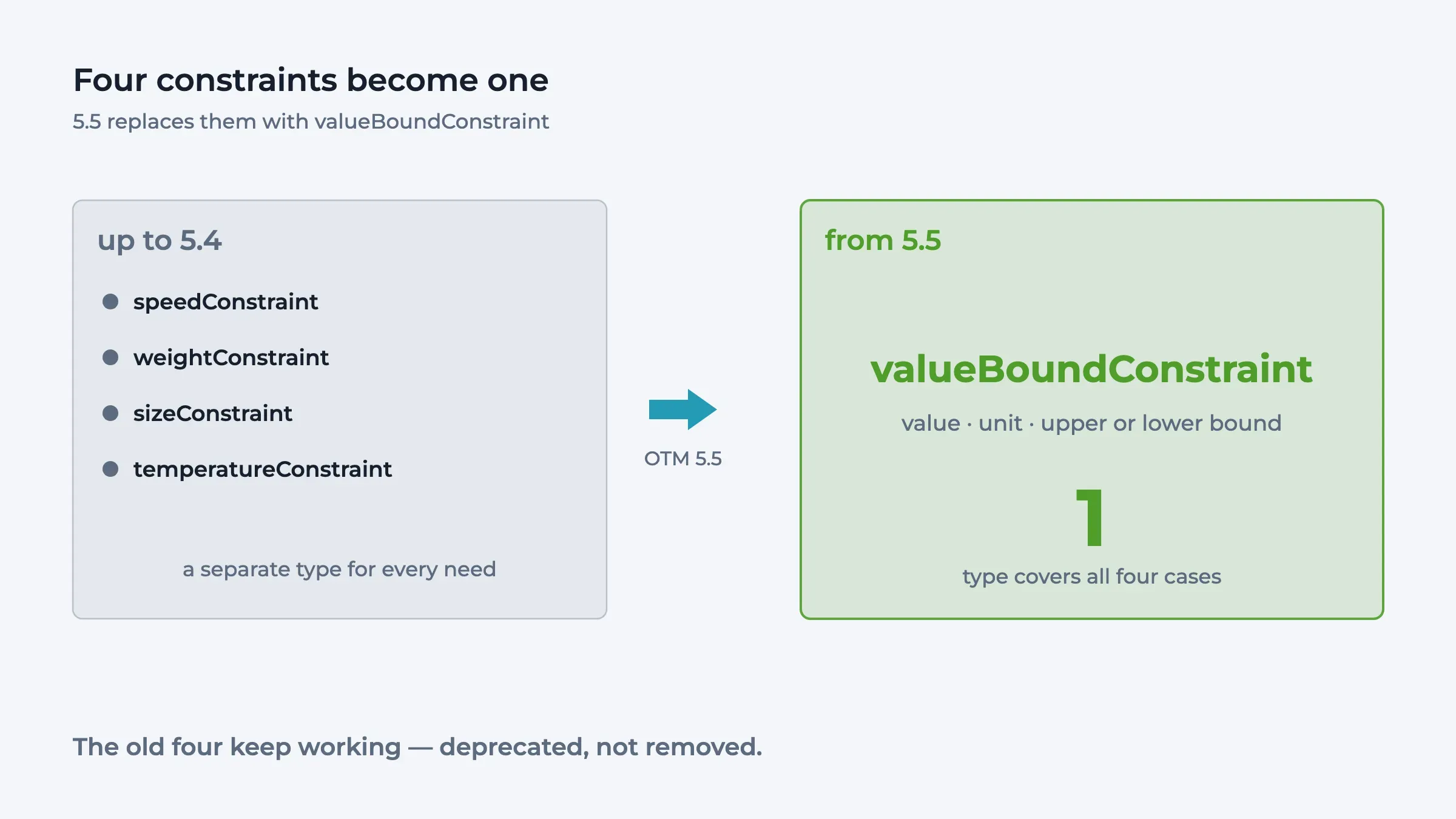
On 7 February 2023, nine change requests closed and OTM 5.5 was out. It is an unusual release in the 5.x series, because its most striking change makes the standard smaller rather than bigger. The reason was stated plainly in the discussion: every release brought new constraint types, and the list was becoming unworkable for newcomers.
Back to basics: what is OTM? The Open Trip Model is the open standard transport and logistics parties use to exchange trip data: trips, consignments, transport orders, vehicles, locations, goods and events, as lightweight JSON over a REST API. What makes it matter is who owns it. Since 2018 OTM has been stewarded by the Stichting Uniforme Transport Code, together with TLN, evofenedex and DALTI, and changes are debated in the open on GitHub. No single vendor decides on their own what goes into the standard. That is why a shipper, a carrier and a road authority can describe the same trip the same way, and why no per-integration translation layer is needed.
The problem: constraints outgrew themselves
Constraints are how OTM expresses what must or must not happen: at most 25,000 kg, no higher than 3.80 metres, unload between 07:00 and 10:00, refrigerated transport, driver with ADR certification. Every new need produced a new constraint type; 5.4 added one more for transport equipment in May 2022. Speed, weight, dimensions, temperature: each defined separately, each with its own documentation. Precise, but the list grew long, and anyone building their first OTM integration could no longer see the wood for the trees.
The working group made an explicit choice: merge what resembles each other.
valueBoundConstraint replaces four of them
The answer is a single constraint with a value, a unit and an upper or lower bound. That covers speed, weight, dimensions and temperature with one pattern. Important for anyone already integrated: the old constraints are deprecated, not removed. They remain supported. That is a deliberate stance in OTM, and it is the difference between a standard you can follow and a standard that breaks your integration.
In fairness, the working group wrote down the downside themselves: this hides complexity. There are fewer types to implement, but no fewer situations to think about. What you gain is that getting started stays comprehensible.
Low-emission zones, road closures, fuel and the rest
Two additions concern access to the road itself, precisely where planning and policy meet.
emissionStandardConstraint: the emission class was already on the vehicle, but you could not express that a route, trip or location requires a minimum class. For driving into a low-emission zone, that is exactly the piece of information the planner needs.accessConstraint: a new constraint type with valuesclosed,partialClosedandopen, to describe (temporary) road closures. The reason it was not allowed to be a generic constraint: a generic one cannot tell a routing engine that this road is shut, and so cannot make it compute an alternative.
The remaining changes:
fuelbecomes an enum instead of free text. As long as everyone could pick their own spelling, the field was not machine-usable, a problem the moment you want to calculate emissions from it.- New
refuelaction: covering both refuelling and charging; the fuel type makes the distinction. Previously you had to abuse a generic action for it. transportOrderon the consignment: the association only worked one way. In OTM entities usually point both ways, so this was an inconsistency.- EORI number as a contact detail: the EU registration number needed for customs handling.
- Documentation on constraints: when a constraint belongs on the consignment and when on the goods themselves. Not a specification change, but the most frequently asked question.
What you notice in practice
5.5 is the release you only appreciate once you build planning that meets the real world. A city centre with a low-emission zone, a bridge under maintenance, a chilled consignment that only fits certain vehicles: these are not edge cases, this is Tuesday.
For Keana, our planning software for green city logistics, this is the kind of information the entire bundling problem turns on. Which vehicle may enter that zone, which street is shut this week, and which stops can therefore be combined into one trip. See the Keana case.
A standard that only grows is one nobody fully implements
OTM 5.5 took something back for the first time: one valueBoundConstraint instead of four, with the old ones deprecated but still working. Alongside that, low-emission zones, road closures, fuel as an enum, a refuel action, the transportOrder reference on the consignment and EORI as a contact detail.
That the working group dared to prune is, to me, the most important thing about this release, more important than what was added. A standard that only ever grows becomes a standard nobody fully implements, and then everyone builds their own translation layer again anyway. If you have an integration still using the old four constraints: migrate at the next change, not "some day". We do that kind of integration migration regularly, and it is always manageable as long as you do not leave it lying.

Optimize with ZEN's Expertise
Upgrade your development process or let ZEN craft a subsystem that sets the standard.
Custom software, built and run
Applications that follow your process, not the other way round. From first sketch to production, and we keep them running after that.
Read more:
OTM 5.8: A Vehicle May Finally Have More Than One Fuel
OTM 5.8 shipped on 13 March 2026. Its most striking change deprecates a field that 5.4 had only just added: one fuel per...
OTM 5.7: The Actor Becomes a Company or a Person
After eighteen months without a release, OTM 5.7 shipped on 23 May 2025. Its main change touches something nearly every ...
OTM 5.6: The Release Where Government Joined In
OTM 5.6 shipped on 17 November 2023. It is the release where you can see the standard is no longer used by carriers alon...
Remote Development in the Cloud
Remote development has become increasingly popular in recent years. It allows developers to take advantage of powerful c...

From monolith to microservices using the strangler pattern
The strangler pattern is a technique from Dave Farley’s ‘Continuous Delivery’ for transforming a monolithic software sys...
OTM 5.4: Fuel and CO₂ Become Part of the Standard
On 9 May 2022 eleven change requests closed and OTM 5.4 was done. Its most important addition is one you only appreciate...