OTM 5.7: The Actor Becomes a Company or a Person

Eighteen months separate OTM 5.6 and 5.7. That is the longest silence in the entire 5.x series, and the release that followed was proportionate. The release candidate appeared on 16 May 2025; on 23 May 2025 the documentation was officially marked as 5.7. What it contains is the largest intervention in the data model since 5.4.
Just to be sure, what is OTM again? The Open Trip Model is the open standard for exchanging logistics trip data: a trip, a consignment, a transport order, a vehicle, a location, the goods inside it and the events around it, as lightweight JSON over a REST API. The value is not in the format but in the agreement. OTM is stewarded by the Stichting Uniforme Transport Code together with TLN, evofenedex and DALTI, and every change is proposed, debated and labelled in the open on GitHub. Anyone building an OTM integration can read back exactly why a field exists. That is rare, and it is the difference between implementing a standard and reverse-engineering a vendor format.
The problem: everything was a contact detail
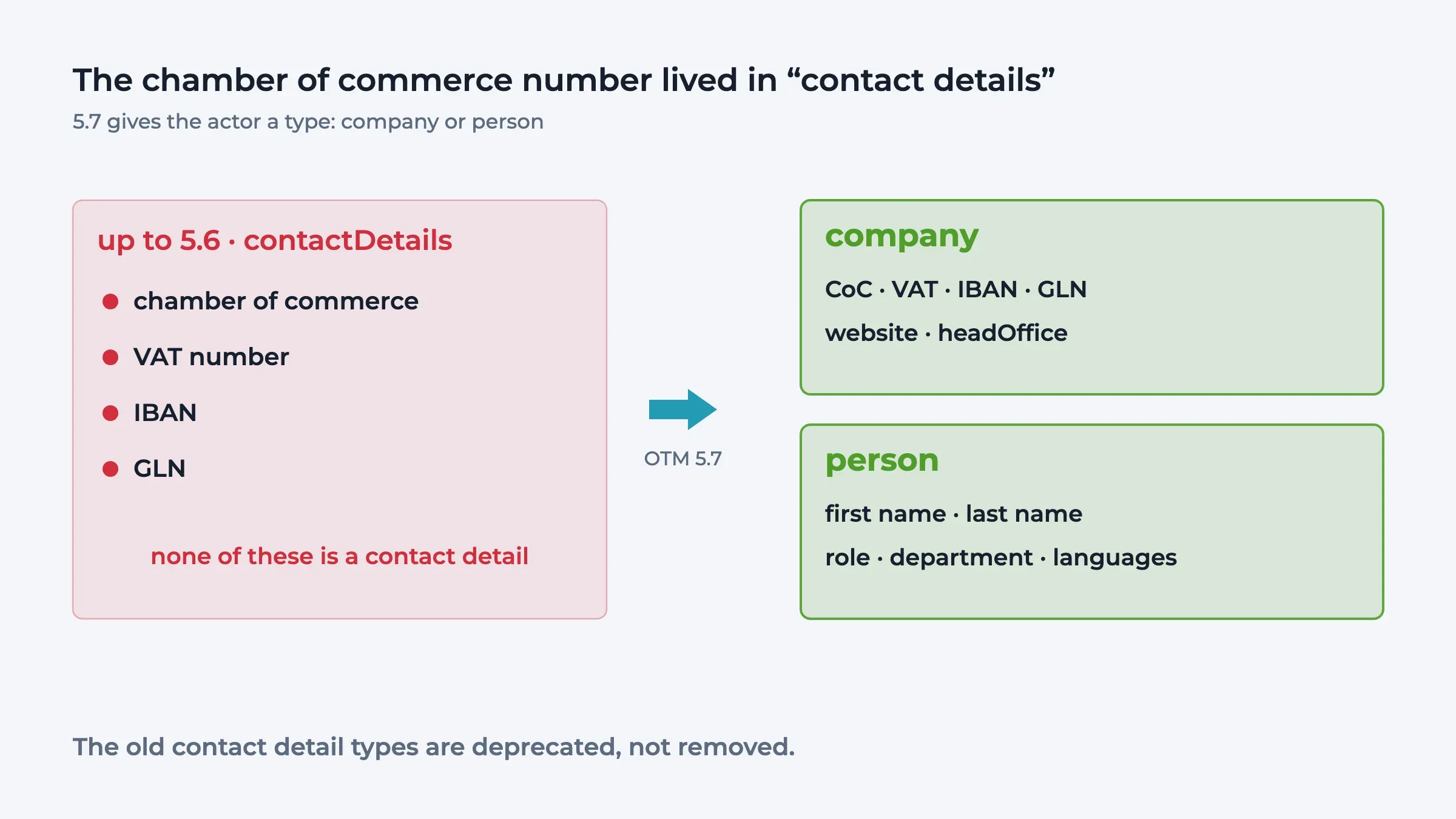
In OTM up to and including 5.6, an actor was a name with a role and a list of contactDetails. If you needed to record a party's chamber of commerce number, VAT number, IBAN, website or GLN, it went into contactDetails.
That worked, in the way a kitchen junk drawer works. But a chamber of commerce number is not a contact detail, and the consequence was that every new integration required a fresh agreement about which type you used for which kind of identifier. Precisely the problem a standard is supposed to solve.
The fix: actors get a type
5.7 makes the actor type-specific, just as action and event already were. Two types to start with: company gets its own fields: chamber of commerce number, VAT number, IBAN, website, GLN, a headOffice association to a location, and an actors list for sister companies or employees. person gets: first name, last name, role, department, and the languages someone speaks.
The contact detail types this made redundant (GLN, vatcode, iban, name, firstName, lastName and other) are deprecated. Note the word deprecated. They are not removed. That is how OTM handles this sort of intervention: the new form arrives, the old one keeps working, and you migrate when it suits you. Your integration does not break on release day, but it does become dated, and it pays to plan when you follow. Alongside it came a second, smaller correction attacking the same problem from the other side: the GLN belongs directly on the location, not on an actor or on contact details. That is substantively right (a GLN identifies a physical place, not an organisation) and it makes the field findable for anyone looking up a location rather than a party.
Better failures, and some tidying up
The second thread in 5.7 is about what goes wrong en route. An action could already succeed, fail, partially succeed or be cancelled, with only damage and receiverAbsent as reasons. For most real situations that is too little, so everyone fell back on the free-text remark field, after which nothing can be done with it programmatically.
5.7 extends the reasons with:
incomplete: delivered, but not in full as agreed.deliveredElsewhere: delivered, but not at the agreed place. A different dock, or the neighbours.locationUnreachable: the driver could not get there: gate shut, road up, barrier locked.rejected: the receiver refused the goods.
And in the same spirit: distance per move, so you can send the actually driven distance of a movement instead of reconstructing it afterwards.
Four changes are pure consistency work, and those are exactly what makes a specification implementable:
fuelStationandterminalas new location types. Therefuelaction has existed since 5.5; the place where you do it deserves its own type too.geoReferencesbecomesgeoReferenceon a route. Everywhere else in the specification this object is singular; only on routes was it plural, even though there too it is exactly one geographical representation.arbitraryJsonBlobgets a proper name instead of a description with spaces in it.- A broken reference at
goods.packagingMaterialstraightened out.
What to do if you already integrate
Three things, in this order. First: check whether you use geoReferences on routes. That is the only rename in this release that can quietly yield an empty value instead of an error. Then: inventory where you have stuffed identifiers into contactDetails. They keep working, but every new counterparty will expect them in the new place. And finally: if you do anything with exception handling (not delivered, refused, unreachable), then from 5.7 onwards you can stop parsing free text. That is usually the change that pays off fastest.
In Keana the last one is immediately visible: a stop that failed because the location was unreachable calls for different rescheduling than a stop where the receiver refused the goods. As long as that difference lives in a remark field, your planning can do nothing with it. See the Keana case.
Plan your migration, even though nothing breaks
OTM 5.7 makes the actor type-specific with company and person, moves the GLN to the location, extends the result reasons with incomplete, deliveredElsewhere, locationUnreachable and rejected, gives a move a distance and adds fuelStation and terminal as location types. Eighteen months of silence, then the biggest change since 5.4.
Because OTM deprecates rather than removes, nothing breaks on release day, and that is precisely the risk: nobody feels the need to migrate until the first new counterparty expects the chamber of commerce number in its new place. My advice is to schedule the migration from contactDetails to the new actor fields now, and to check the geoReferences rename today, because that is the one that hits your integration most quietly. If you want help with that: it is the daily work of our custom software development.

Optimize with ZEN's Expertise
Upgrade your development process or let ZEN craft a subsystem that sets the standard.
Custom software, built and run
Applications that follow your process, not the other way round. From first sketch to production, and we keep them running after that.
Read more:
OTM 5.8: A Vehicle May Finally Have More Than One Fuel
OTM 5.8 shipped on 13 March 2026. Its most striking change deprecates a field that 5.4 had only just added: one fuel per...
OTM 5.6: The Release Where Government Joined In
OTM 5.6 shipped on 17 November 2023. It is the release where you can see the standard is no longer used by carriers alon...
Remote Development in the Cloud
Remote development has become increasingly popular in recent years. It allows developers to take advantage of powerful c...

From monolith to microservices using the strangler pattern
The strangler pattern is a technique from Dave Farley’s ‘Continuous Delivery’ for transforming a monolithic software sys...
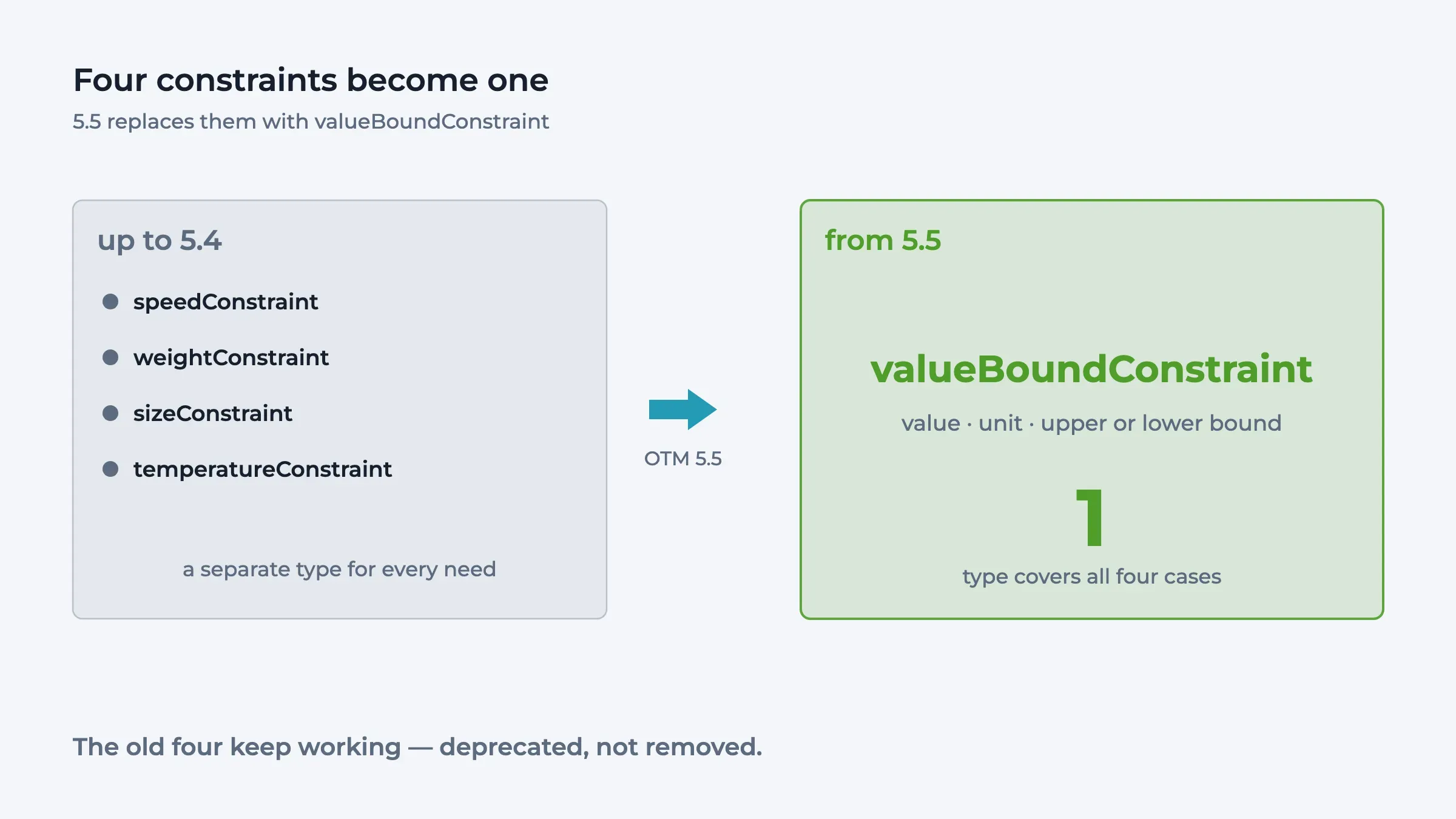
OTM 5.5: Fewer Constraints, More Modelling Power
OTM 5.5 shipped on 7 February 2023 and is the first release where the standard deliberately took something back instead ...
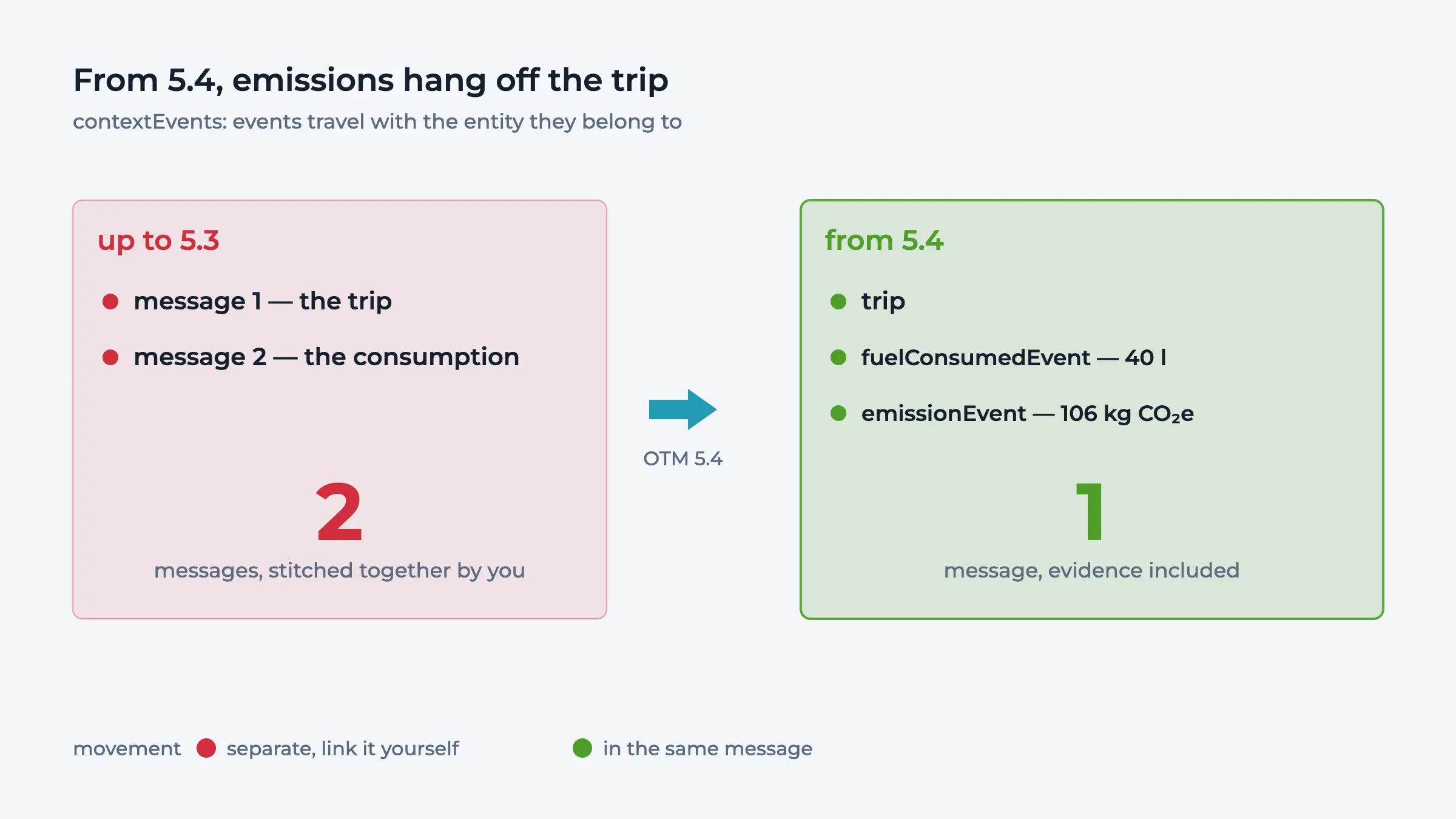
OTM 5.4: Fuel and CO₂ Become Part of the Standard
On 9 May 2022 eleven change requests closed and OTM 5.4 was done. Its most important addition is one you only appreciate...