AI-Assisted Development under GDPR, NIS2 and DORA


The moment you attach a coding agent to your codebase, you touch three regulatory regimes at once. Not because AI is separately regulated (the AI Act is its own story), but because AI tooling touches existing rules in places your delivery pipeline never had to think about. You send code to a third party, you pull in dependencies nobody chose by hand, and you change what proposes a production change.
This article covers the engineering side. It is not legal advice; for the precise scope in your situation you need your own counsel or compliance officer.
The names first, and what changes once AI is involved
There is immediate confusion here, and it is sharper at ZEN because we use both meanings daily.
- GDPR (AVG in Dutch): covers personal data: what you process, why, and where it ends up.
- NIS2: the EU directive on cybersecurity for essential and important entities. Emphasises risk management, supply-chain responsibility and incident reporting. National transposition has run late in several member states, the Netherlands included, so check the current status before planning against a date.
- DORA: two different things. The Digital Operational Resilience Act applies to the financial sector and covers ICT risk and your reliance on third-party ICT providers. DORA metrics are the four delivery measures from DevOps research. They are unrelated, and in any meeting with both compliance and engineering in the room, that is five minutes well spent.
The rules are not new. What changes is where they land. Previously your code went from repository to pipeline to production, entirely inside boundaries you drew. With a coding agent, part of that code, and sometimes the context around it, goes to a service you do not operate. That is no catastrophe, but it is a processing activity and a dependency, and you need to be able to name both.
GDPR: where does your context go?
The core question is not "do we use AI" but "what are we sending".
Code itself is usually not personal data. The context around it can be: a test fixture with real customer names, a stack trace containing email addresses, a database dump somebody pasted in to look something up, a log file attached to explain a bug.
What you practically want to know:
- Which tooling sends what outside? IDE plugins, CI integrations and agents differ substantially in what they transmit.
- Where does processing happen? Region and sub-processors matter, exactly as with any other cloud service.
- Is your input used for training? Usually switchable on business plans, but it is a deliberate decision somebody has to make and record.
- Are those tools in your processing register? If AI tooling is widely used but recorded nowhere, that is the first gap anyone will notice.
NIS2: your AI vendor is now in your supply chain
NIS2 puts significant weight on supply-chain security. An AI coding assistant with write access to your repositories, or one running inside your pipeline, is part of that chain. So the questions you already ask other vendors apply here: what access does this have, what happens if it fails or is compromised at their end, and how would we find out?
One thing is specific to AI tooling: dependencies nobody chose. If an agent proposes a package and it passes review, a supplier has been added to your chain by a model. That is exactly the kind of decision NIS2 wants visible, so do not leave your dependency scanning and your approval route for new packages untouched as volume rises.

DORA: evidence, not just policy
If you fall under the Digital Operational Resilience Act, the bar moves from "we have a policy" to "show me". You need to be able to show which third-party ICT services you rely on, what risks attach to them, and how your system behaves when something fails. An AI coding service involved in producing your production code belongs in that register.
The practical consequence is documentation that is not separate from your system: which tooling was involved in a change, who approved it, and evidence that your controls actually ran. Pulled out of your pipeline, that is not extra admin. Reconstructed by hand afterwards, it is a great deal of work.
What to put in place, and why it is engineering work
Four things that serve all three regimes at once, none of them expensive:
- Record which AI tooling runs where, and what it may do. One register, with access and processing location. This is the first document anyone asks for.
- Flag AI-assisted changes. A PR-level marker is enough. It makes both your risk conversation and your impact measurement possible; without it, both are guesswork.
- Automate your controls in the pipeline. Dependency scanning, secret detection, infrastructure policy checks. As code volume rises this is the only thing that scales; manual review does not.
- Keep the evidence that those controls ran. Because "we always scan" is not an answer and a pipeline log is.
AI tooling rarely introduces a new regime. It relocates existing obligations into your delivery pipeline: GDPR is about what you send, NIS2 about who is in your chain, including the dependencies a model proposed, and DORA about whether you can evidence it.
All three converge on the same point: knowing what happens in your pipeline, and being able to show it. Treat that as a compliance exercise and you will build a separate administration around it that falls behind the moment the second agent is switched on. Treat it as engineering and the evidence comes out of the pipeline itself, for free. I would not roll out a coding agent widely before that second option is in place, and setting it up in your cloud environment is exactly where our cloud and platform work usually starts.
Go Cloud Native, Go Big
Revolutionise your organisation by becoming a born-again cloud enterprise. Embrace the cloud and lead the future!
AI engineering
Use AI where it genuinely helps, with accountability staying with people.
Read more:
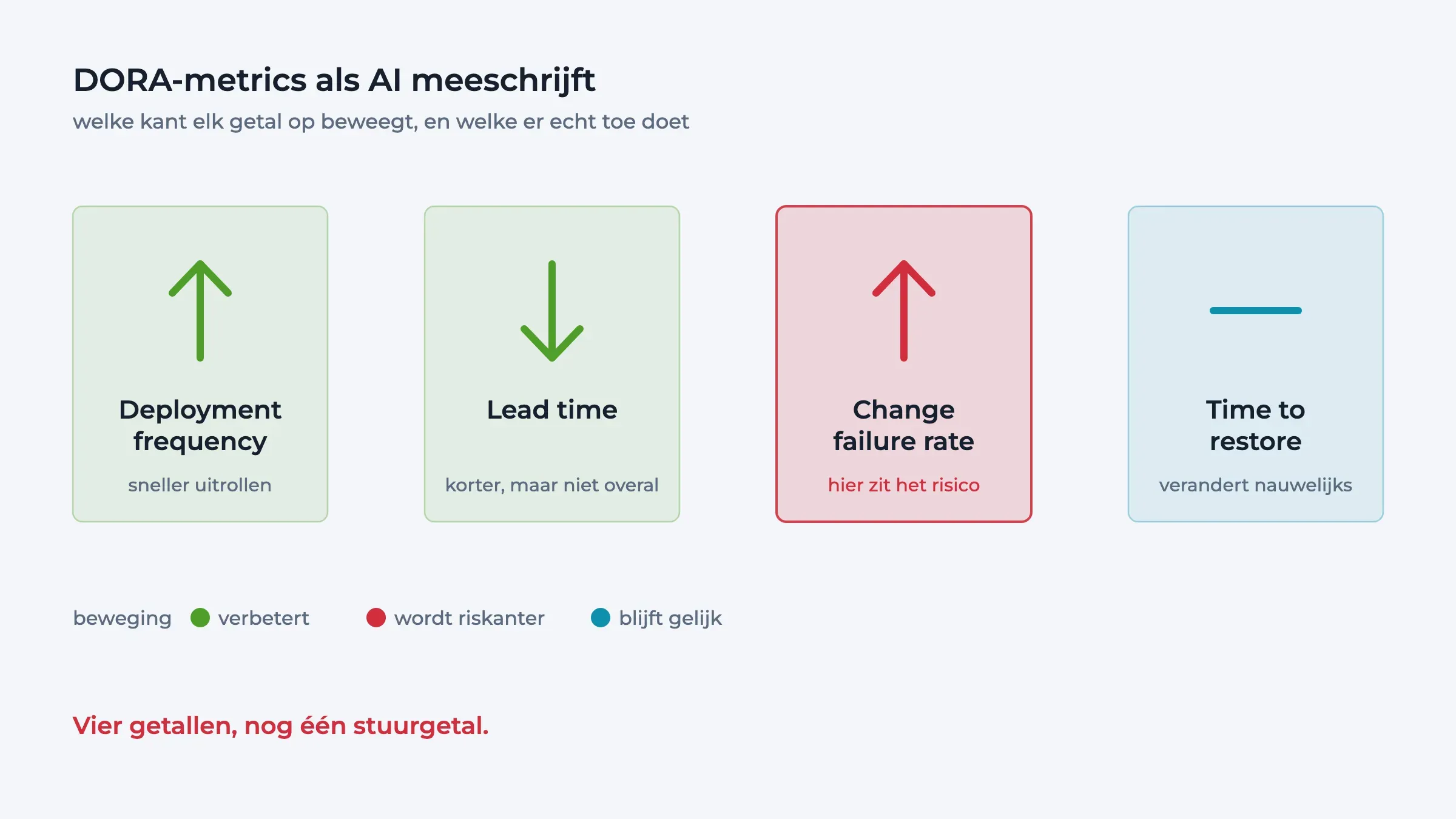
Reading DORA Metrics When AI Writes Half Your Commits
Your DORA dashboard still shows the same four numbers. They no longer mean the same thing. Once a serious share of your ...
In 1988 a student took down a tenth of the internet. What did we do next?
In November 1988 a student at Cornell wrote a small program to count how many computers were on the internet. A bug took...
OpenAI's AI agents broke into another company. So why are we calling it a conspiracy?
OpenAI's AI agents broke into Hugging Face, another AI company, this summer. Dwarkesh Patel called it an AI civilisation...
A $200 AI subscription delivers $14,000 of compute. But does the maths hold up?
A $200 ChatGPT Pro subscription supposedly delivers $14,000 a month of compute. That is how the screenshot goes round. I...

Reviewing AI-Generated Infrastructure Code: What to Actually Look For
Application code that is wrong usually breaks. Infrastructure code that is wrong works. And that is exactly the problem....
What Thirty Minutes of Waiting per Engineer per Day Really Costs
Half an hour a day. It sounds like nothing. But work it through and it is €5,000 per engineer per year, or half a millio...