What Thirty Minutes of Waiting per Engineer per Day Really Costs

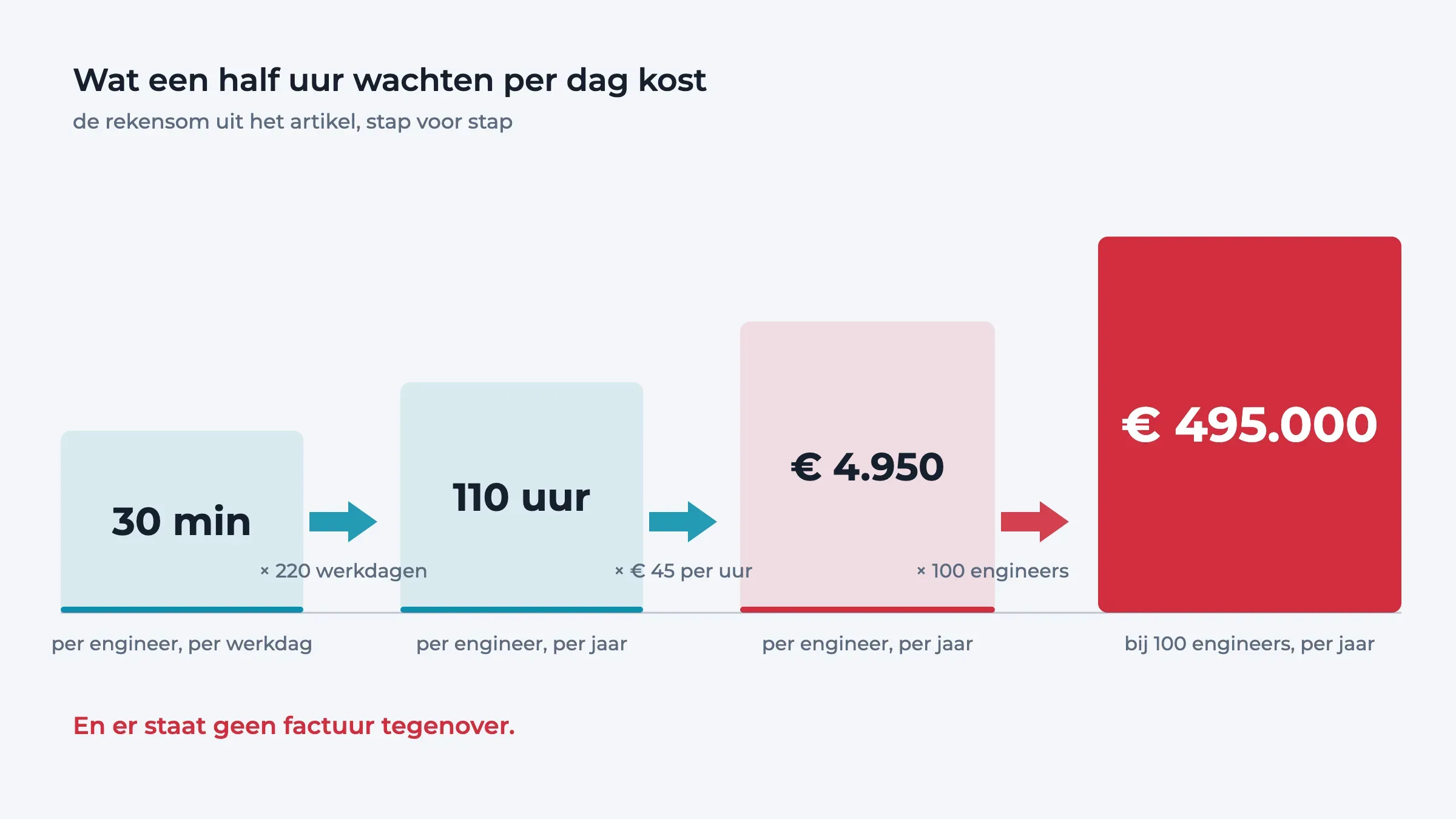
Half an hour a day. It sounds like nothing.
You wait for a build. You wait for someone to look at your pull request. You wait for an environment to free up, for an approval, for a pipeline that takes twelve minutes to do something that should take two. Nobody logs it, because it does not feel like time you are losing. It feels like the work. Work it through and it is €5,000 per engineer per year. At a hundred engineers, half a million euros. Every year, on no line of your P&L.
The arithmetic
There is no trick in it. You can check it against your own numbers:
- Half an hour per working day is 2.5 hours a week.
- At roughly 220 working days a year, that is 110 hours per engineer per year.
- At a loaded cost of about €45 an hour, that comes to €4,950, call it €5,000.
- A hundred engineers: €495,000 a year.
Substitute your own rate. The point does not change: this is not a rounding error, it is a payroll line the size of a small team, and there is no invoice attached to it.
Where the thirty minutes goes, and why nobody sees it
Once you start watching for it, it is almost never one big block. It is small pieces that accumulate:
- Waiting on builds and tests. An eight-minute pipeline run five times a day is forty minutes. If it is flaky, you run it more often than that.
- Waiting on review. Usually the largest single component, and almost never measured separately. Your pull request is ready; your colleague is in a meeting.
- Waiting on environments. One staging, three teams.
- Waiting on approvals. Somebody has to tick a box and that somebody has other things on today.
- The hidden cost of switching. This is the cruellest one. Fifteen minutes of waiting rarely costs fifteen minutes: you start something else, and finding your way back to where you were costs another ten.
You see cloud costs and licences because an invoice arrives. Waiting comes from nobody, so it arrives nowhere. There is also no moment where anyone decides. Nobody ever approved an eight-minute pipeline; it grew there over two years, one reasonable step at a time, and every individual step was defensible. And the people it hurts most are precisely the people least likely to raise it. Waiting does not feel like something you escalate. It feels like how the work is now.
AI makes this worse, not better
This is the part that catches most teams out. If code gets written faster, there is not less waiting. There is more: more changes reach the review queue sooner, and the same reviewers and runners have to divide themselves up. The bottleneck does not disappear, it moves to where no model can reach it.
Which is exactly why making code cheaper does not remove the cost but concentrates it. We set that argument out in where we stand on AI in software engineering: once writing stops being your constraint, everything around it becomes your constraint, and only then do you find out whether you ever measured it.

How to measure it and what to do about it
This does not need a programme. Three things surface most of it:
- Break lead time into phases. A single number from commit to production hides exactly what you are looking for. Once writing, waiting for review, testing and deploying are separate, the largest component announces itself.
- Measure review latency on its own. The time between "ready for review" and "somebody looked at it". In most teams this is the biggest single component, and almost nowhere is it on a dashboard.
- Measure pipeline duration, not just whether it passes. A pass rate tells you nothing about the time you spend waiting for it.
Measure for a month before you change anything. Without a baseline you cannot demonstrate an improvement afterwards, and then the strongest opinion wins the argument. The interventions are rarely dramatic, which is exactly why they never get done.
- Agree a review turnaround. "Pull requests under 300 lines get reviewed within 24 hours" often removes more waiting than any technical change.
- Make pull requests smaller. Smaller changes get reviewed sooner, and the waiting falls faster than the size does.
- Speed up the pipeline with caching and parallel tests. Eight minutes to three, across a hundred engineers, is a serious number.
- Give every change its own environment instead of queueing for shared staging.
- Remove approvals that never block anything. A box that is always ticked delays without controlling anything.
Waiting is the cheapest win you still have lying around
Halve those thirty minutes and across a hundred engineers you recover a quarter of a million euros a year. That is not a saving you have to win in a budget round. You only have to know it is there. Half an hour per engineer per day is €5,000 a year per person and half a million across a hundred. No invoice records it, nobody approved it, and it grows on its own as long as nobody is watching.
My claim: most teams investing in AI tooling right now would get less out of it than out of halving their waiting time, and they do not know it, because they measure the one and not the other. Once writing gets faster, waiting is the only thing left that matters. So measure it before you invest. Otherwise all you will know afterwards is that you produce code faster, not that you deliver anything sooner.
Happy Nerds are productive Nerds
Implement DevOps and SRE super fast with Agile Analytics. Ask our Agile Nerds.
Cloud & platform
Landing zones on AWS and Google Cloud, CI/CD and observability. We set it up, and we keep it running.
Read more:
AI-Assisted Development under GDPR, NIS2 and DORA
The moment you attach a coding agent to your codebase, you touch three regulatory regimes at once. Not because AI is sep...
Reading DORA Metrics When AI Writes Half Your Commits
Your DORA dashboard still shows the same four numbers. They no longer mean the same thing. Once a serious share of your ...
Remote Development in the Cloud
Remote development has become increasingly popular in recent years. It allows developers to take advantage of powerful c...
Twitter fires developers who don't produce enough lines of code?
With Big Tech becoming just a bit less Big these weeks: Facebook firing 10k employees, Twitter halving its workforce on ...
In 1988 a student took down a tenth of the internet. What did we do next?
In November 1988 a student at Cornell wrote a small program to count how many computers were on the internet. A bug took...
OpenAI's AI agents broke into another company. So why are we calling it a conspiracy?
OpenAI's AI agents broke into Hugging Face, another AI company, this summer. Dwarkesh Patel called it an AI civilisation...