AI Vampires: The Hidden Price of Twenty Agents

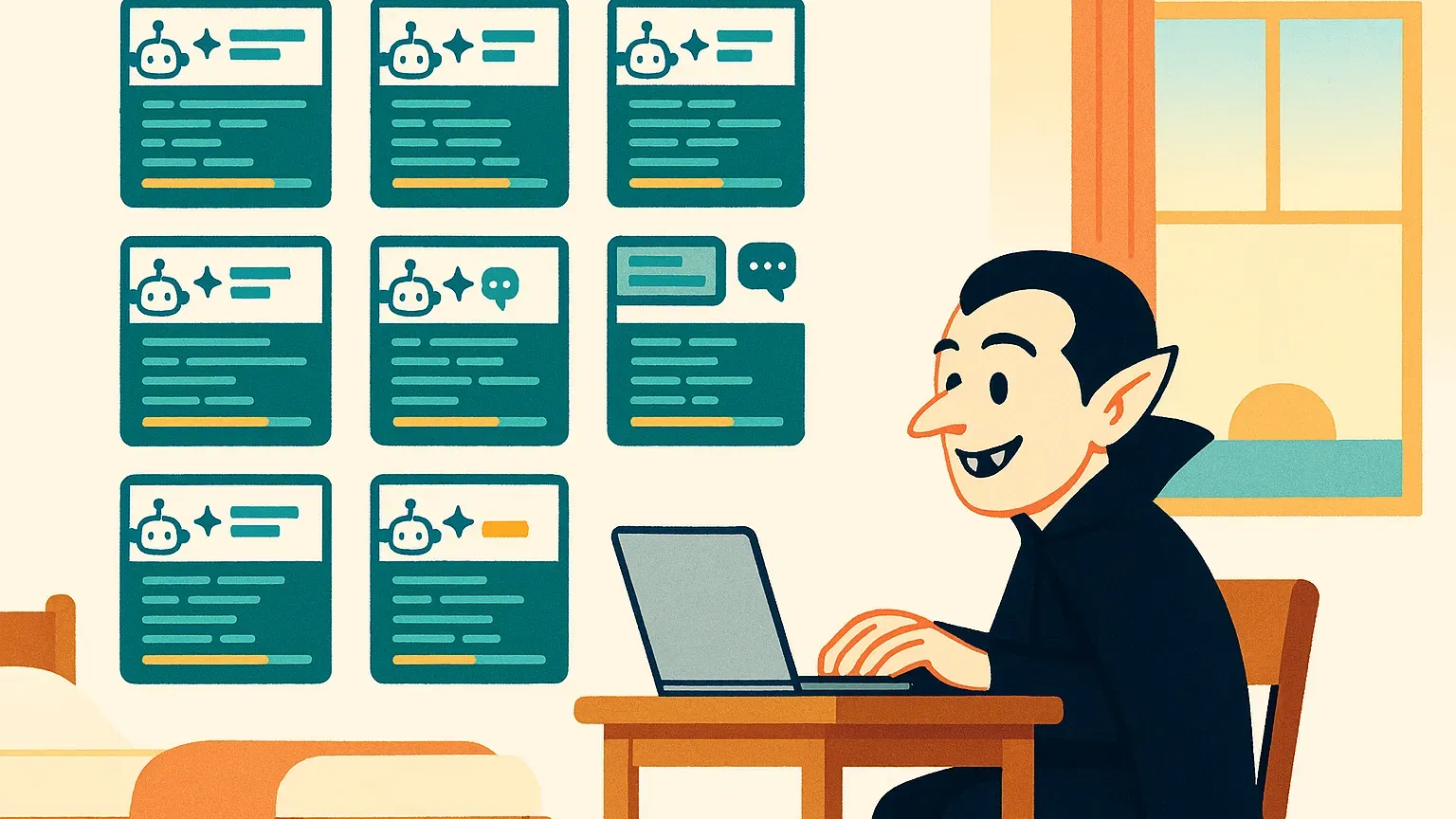
A while back I was still redirecting agents at two in the morning. Nothing had to be finished; I could not stop redirecting. One came back with a result, the next was ready for a new assignment, and every time there was something else waiting for me to have an opinion about. It turns out there is a name for it.
Marc Andreessen, who co-founded Netscape and is now a venture capitalist at Andreessen Horowitz, described a term on the Joe Rogan Experience that he says is going round the Valley: the AI vampire. His definition: "it's when AI turns you into a vampire. You're up all night doing AI coding… You're getting so much done that you can't turn off." He tells it as a success story, and starts from a genuine puzzle: if agents make you twenty times more productive, you would expect programmers to work less. "What's actually happened is virtually to a person, they're all working more hours than ever." Then comes the passage that stayed with me, about his friends in the industry, some of them quite famous: "when you talk to them now as opposed to six months ago, they look terrible. They're sleep deprived… And they're absolutely ecstatic." Visibly falling apart, and delighted about it: from the inside it does not feel like burnout. Rogan's response is the sharpest line in the whole conversation: how much Adderall has been sold by now?
The ten-minute leash
The mechanism Andreessen describes is latency. You give an agent an assignment, it works for about ten minutes and comes back "like a puppy" with a result. You evaluate it and hand over the next one. Except those ten minutes are dead. So you open a second pane. And a third. "The state-of-the-art today in the valley is 20 bots at a time." Your job has become a polling loop with a ten-minute interval. And there is the trap, in Andreessen's own words: "The opportunity cost of going to sleep is too high because if you go to sleep, you won't be with your 20 AI coding agents." Sleep is no longer rest, it is downtime for a crew you are responsible for.
What disappeared along the way, he names himself, without drawing the conclusion. On the old model: "you have to spend like two hours refamiliarizing your brain with all the code, then you work for 10 hours, then you spend two hours trying to unplug." Two hours to ramp up, two hours to ramp down. That ramp-down was the way back, and the agent loop deleted it. There is nothing left to unplug from, so you never do: there is no longer a moment at which it is finished.
"Absolutely ecstatic" is the symptom, not the reassurance
Andreessen is not hiding the damage; he points at the bags under their eyes himself. My objection is that he files them under upside, and that is the wrong column. In any other trade, "he looks awful, he doesn't sleep, and he thinks it's wonderful" is not a productivity figure but a reason for a conversation. We have written before that constant AI assistance wears you down. This is the next stage of that: the enjoyment itself keeps you awake, which is why you see the exhaustion coming too late.
The finish line is gone
There is a second layer underneath. Twenty times the output does not produce less work, because demand moves with it: "every company has a thousand things they've wanted to have code for that they've never been able to get to." He presents that as good news: no unemployment, elastic demand. And he is right, and we argued ourselves that code is getting cheap and engineering isn't. But read the same fact from the other side: the backlog is now infinite by construction. There will never again be an evening on which the list is empty, and that list is what used to make people stop. Remove the finish line and put nothing in its place, and all you are left with is the vampire. DHH now runs sixteen agents at once across four machines, and what makes that work for him is his judgement about what does not need building. Drawing boundaries is organisational work, not a tooling choice.
Marc Andreessen on Joe Rogan. The passage on AI vampires starts around 2:08.
What I do about it, and what we do at ZEN
I am not an outsider here; I was the one still redirecting at two in the morning. So no sermon, just what I have agreed with myself, and what belongs in a team agreement as far as I am concerned:
- A cap on parallel agents. The number decides how finely your day is shredded into ten-minute blocks. At three you can still think, at twenty you are a dispatcher.
- A hard stop time, and no agent starts work after it. A running agent is a reason to come back. That has to end before you do.
- Overnight output gets reviewed in the morning. At two in the morning you are not reviewing, you are approving.
- "Done" is a decision, not an empty queue. If the backlog is infinite, someone has to say out loud that this was enough. If you don't, the tool never will.
None of that is a technical problem. Which is also Andreessen's own escape hatch, at the end of the same conversation: "the fundamental moral and ethical issues are still the ones we have to answer." Fine, then this is one of them, and this is my answer. At ZEN this now sits in how we work: agents run inside agreed limits, review happens rested, and the question of whether something should be built comes before whether an agent can build it; that second answer is always yes these days. That is what our AI-native software engineering and AI consultancy is about: a pace you can still sustain next quarter.

Happy Nerds are productive Nerds
Implement DevOps and SRE super fast with Agile Analytics. Ask our Agile Nerds.
AI engineering
Use AI where it genuinely helps, with accountability staying with people.
Read more:

My AI Agent Works Through the Night. It Just Can't Decide Anything.
Since August, an agent runs every weekday at half past seven, reads our open merge requests and forms an opinion on each...

What you're missing with AI agents is rarely a tool
I have been running several AI agents side by side for months. After five hours of DHH on programming with agents, my to...
The creator of Ruby on Rails doesn't write code any more
The creator of Ruby on Rails no longer writes a line of code himself and drives sixteen agents at once. From five hours ...

AI is the missing piece of the Productivity Puzzle
Today, I’d like to plea that Artificial Intelligence (AI) is the missing piece of the productivity puzzle, revolutionizi...

Hallucinating AI - ChatGPT suggests APIs that never existed
I was debugging a piece of code that threw a Java.lang.OutOfMemoryError. After a short investigation, I spotted that the...
Remote Coding Job Interviews are DEAD because of Nvidia and ChatGPT
With the rise of remote work, remote coding job interviews have become increasingly popular. However, this shift has bro...