AI Makes Code Cheap. Your Organization Is Still Expensive.


In early 2025, METR ran a randomised controlled trial on sixteen experienced open-source developers, working on repositories they had contributed to for an average of five years. Tasks were randomly assigned to allow or forbid AI tools, mostly Cursor Pro with Claude 3.5 and 3.7 Sonnet. Before starting, the developers expected AI to cut their completion time by 24 percent. Afterwards, having done the work, they estimated it had cut it by 20 percent. Measured, they were 19 percent slower than without the tools.
Sixteen developers is a small sample. The tooling was early-2025. And these were people with deep knowledge of mature codebases, which is close to the least favourable case for AI assistance. The authors are careful about all of this, and so should you be. What the study establishes is narrower and more useful than "AI doesn't work": the people best placed to judge were wrong about their own working week, and wrong in the flattering direction. I bring it up because almost every conversation I have about AI and delivery runs on self-report. Someone feels faster. The team feels faster. Nobody has looked.
The sketch everyone draws
When you do look, and the delivery numbers have not moved the way the feeling suggested, most engineering leaders reach for the same picture: Idea → AI implementation: 20 minutes → organization: 12 days → production.
Those numbers are illustrative. I chose them to have something to point at, and nobody should repeat them as data. The shape, though, is one most people recognise on sight: the writing collapsed and everything around the writing did not. Refinement. The architecture call. The security review. The reviewer who is in workshops until Thursday. It is a satisfying picture, and it lets everyone off the hook. It is also not quite what the evidence says happened.
The organisations did get faster
DORA's 2025 report, State of AI-assisted Software Development, published on 23 September 2025, reversed one of its own earlier findings. The 2024 edition had associated AI adoption with decreased delivery throughput. The 2025 edition states: "Unlike last year, we observe a positive relationship between AI adoption on both software delivery throughput and product performance." So the twelve days compressed. With 90 percent of respondents using AI at work, output went up and delivery throughput went up with it. If your mental model is that an organisation does not move, that is the number that should bother you: the change board that met on Wednesday afternoons for two years now does it asynchronously, and nobody announced that as a transformation.
The same report, in the next breath: "However, AI adoption does continue to have a negative relationship with software delivery stability."
What they paid for it
Read those two sentences together and the story stops being about speed. Organizations absorbed the extra output and shipped more of it. What they gave up was confidence that what they shipped worked. DORA's explanation is a mechanism rather than a metaphor: "AI accelerates software development, but that acceleration can expose weaknesses downstream. Without robust control systems, like strong automated testing, mature version control practices, and fast feedback loops, an increase in change volume leads to instability."
The framing the report settles on is that AI acts as an amplifier. It does not fix an organization and it does not break one. It takes what the organization already does and does more of it, sooner. A team with fast tests, small changes and short feedback loops gets a faster version of itself. A team whose testing was already thin gets to discover that at four times the volume. That is a better argument than the sketch, and a less comfortable one. Your organization is not expensive because it is slow. It is expensive because it is what gets multiplied.
The minutes are not where the days are
We have written about the tactical layer of this more than once. Waiting costs real money and almost nobody measures it. Review capacity becomes the binding constraint. Your CI/CD pipeline is probably the slowest thing you own. All of that is true and all of it is worth fixing. But notice the unit. Pipelines and reviews are measured in minutes and hours. The twelve days in that sketch are not made of minutes. They are made of decisions: refinement that has not happened, an architectural question waiting on the one person who can answer it, a dependency on a team with its own quarter, an approval that exists because of an incident in 2019 nobody has revisited since.
Decision latency does not respond to throughput. Call it meeting gridlock: you can put more cars on it, it does not get faster. It is set by calendars and by who is allowed to say yes. You can double your engineers' output without moving it at all, because the constraint was never capacity. AI does not amplify decisions either. It amplifies everything queued behind them, which is why the queue is now visibly longer.
What to measure before you invest, and what we do about it
Three things, none of which need a programme:
- Split lead time into phases. Writing, review, testing, waiting for a decision, deploying. A single commit-to-production number hides exactly what you need to see. Once the phases are separate, the largest one announces itself, and it is rarely the one people expected.
- Watch change failure rate next to throughput. This is the DORA finding turned into a local instrument. Throughput rising on its own means little; throughput rising while failure rate rises means you are moving faster into the same wall.
- Count the humans between knowing and shipping. From "someone on the team knows what to do" to "it is running in production", how many people have to agree? That number is your decision latency, and it is almost never on a dashboard.
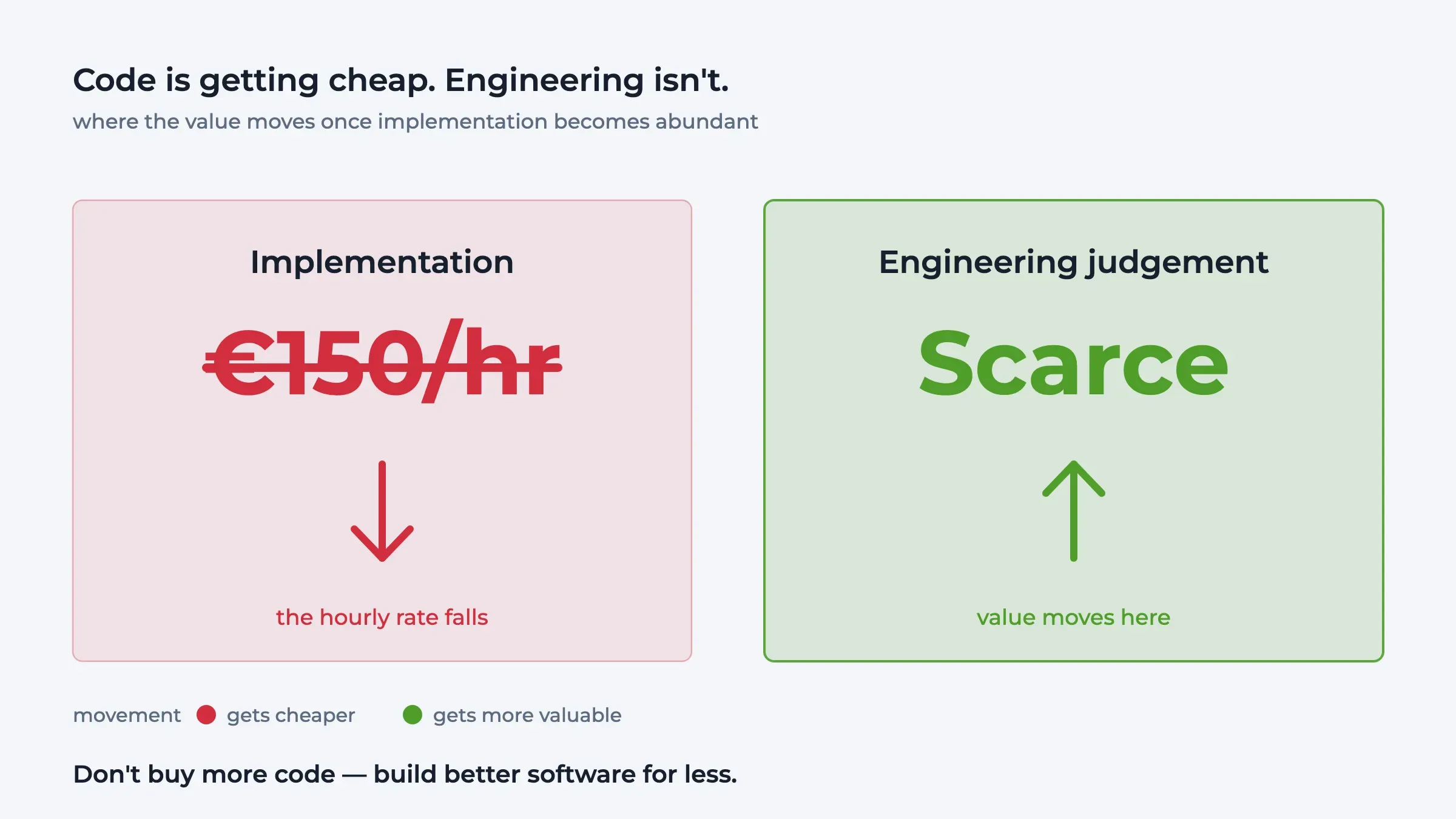
We wrote separately about what happens to the DORA metrics themselves once AI is writing a serious share of your commits: the four numbers stay, their meanings shift. ZEN's position on the first half of this argument is already on the record: code is getting cheap and engineering isn't. This is the second half. Cheap implementation is not a productivity result, it is an input. Whether it turns into a result depends on whether the organization around it can absorb change safely, and that is an engineering problem before it is a tooling one.
That is the work: AI-native software engineering, architecture, testing and delivery that can take the extra volume, and modernising what you already have so that changing it quickly is safe. If your AI numbers look good and your delivery numbers don't, that gap is the interesting part. Talk to us, and bring the delivery numbers.

The Agent Writes It. Who Reviews It?
AI raises your throughput and lowers your certainty. We help teams stay fast without losing control.
AI engineering
Use AI where it genuinely helps, with accountability staying with people.
Read more:

OpenAI's AI agents broke into another company. So why are we calling it a conspiracy?
OpenAI's AI agents broke into Hugging Face, another AI company, this summer. Dwarkesh Patel called it an AI civilisation...

A $200 AI subscription delivers $14,000 of compute. But does the maths hold up?
A $200 ChatGPT Pro subscription supposedly delivers $14,000 a month of compute. That is how the screenshot goes round. I...

My AI Agent Works Through the Night. It Just Can't Decide Anything.
Since August, an agent runs every weekday at half past seven, reads our open merge requests and forms an opinion on each...

What you're missing with AI agents is rarely a tool
I have been running several AI agents side by side for months. After five hours of DHH on programming with agents, my to...
The creator of Ruby on Rails doesn't write code any more
The creator of Ruby on Rails no longer writes a line of code himself and drives sixteen agents at once. From five hours ...
Code is getting cheap. Engineering isn't.
A developer with twenty years' experience stopped coding with AI. Not because it failed, but because it worked too well....