48 major outages in twelve months. What is going on at GitHub?


On 17 August, GitHub was down for the best part of eight hours. One afternoon, and roughly the entire annual budget of permitted downtime was gone. I spent that afternoon staring at a pipeline that was going nowhere, thinking: this isn't the first time this year.
A word up front: this is a soapbox, not a product comparison. We use both GitHub and GitLab, every day, for clients and for ourselves; I don't have a camp. What I did have was an uneasy feeling, and when I went looking for the numbers it turned out not to be a feeling.
The numbers
Between May 2025 and April 2026, according to an analysis of its own status page, GitHub logged 257 incidents, 48 of them major outages, with February 2026 as the worst month. The three nines (99.9 percent) that Enterprise customers are contractually promised were not met over that period.
But the most interesting figure is a different one: 83 of those 257 incidents were caused by load and capacity, by far the largest single cause. So this platform isn't tripping over a bad migration or a broken deploy; it is taking in more work than it can carry. More reported incidents can also mean more openness, I'll grant that, but these reports come from GitHub itself.
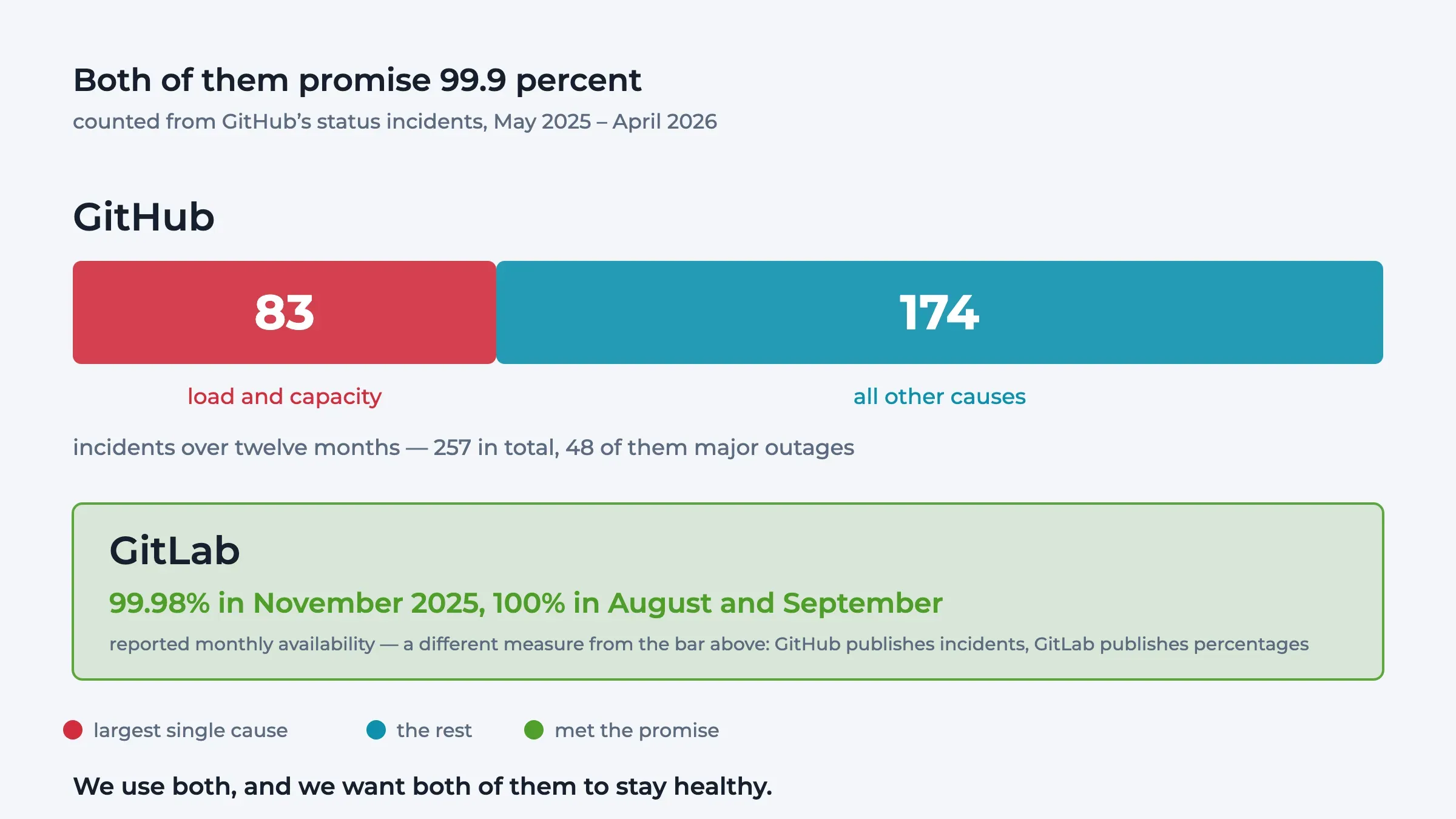
GitHub's incidents between May 2025 and April 2026: 83 of the 257 were caused by load and capacity, by far the largest single cause. GitLab reports a different measure, monthly availability, and came in at 99.98 and 100 percent.
Why this year in particular
That capacity figure is a symptom of the year we're in. A team of ten used to push maybe thirty times a day. That same team with agents alongside them opens pull requests, runs pipelines, does reviews and restarts builds at a rate no capacity plan from five years ago was ever built for.
The result is bitter. Exactly when your platform needs to take the most, it becomes the bottleneck. Your agents sit waiting for a runner. The most expensive part of your toolchain is no longer the model, it's the queue in front of it. We worked out what that waiting costs an engineer per day.
A division, and the reverse Midas touch
In August 2025, Thomas Dohmke stepped down as GitHub's CEO. No successor was appointed; leadership has since reported directly into Microsoft's CoreAI team under Jay Parikh. After nearly seven years as an independently operating unit, the org chart has GitHub down as a division. For years I've been saying Microsoft suffers from a reverse Midas touch: everything they lay a hand on that has anything to do with the internet turns to crap. It's a joke, but the list underneath it isn't. Skype: 8.5 billion dollars in 2011, switched off on 5 May 2025 after 22 years. Nokia: 7.2 billion paid, 7.6 billion written off, plus 18,000 redundancies. Yahoo is my personal favourite, because Yahoo got away: the board unanimously rejected Microsoft's 44.6 billion dollar bid of February 2008 and sold the core business eight years later for 4.5 billion.
But here I have to correct myself, and I'm happy to: with GitHub, for seven years, it didn't happen. Seven years in which GitHub simply stayed GitHub, with its own CEO and a product direction that didn't come out of Redmond. That's the longest remission on the entire list, which is exactly why last year's news is so irritating.
Bitbucket is the warning, not the punchline
Anyone who thinks this is only about Microsoft should look at Bitbucket. Atlassian bought it in 2010 and I was genuinely enthusiastic at the time: Bitbucket Pipelines was among the first to run CI entirely on Docker images, your whole build environment became one line in a yaml file.
The turning point came in August 2019, with the announcement that Mercurial was going. By 1 June 2020 those repositories were gone. Bitbucket was the Mercurial host: that's where it came from, that was its distinction. With that, Bitbucket cleared out its own reason for existing, because it no longer fitted the quarterly plan. What came after is a slow decay that anyone who still logs in will recognise, and for Bitbucket we fear help arrives too late.
Where we stand
Meanwhile GitLab has been doing the same boring trick for years: delivering. Source control, CI/CD, scanning, registry and planning in one product, rather than a marketplace full of integrations you wire together yourself. On availability, GitLab reported 99.98 percent in November 2025 and 100 percent in August and September. Both vendors promise 99.9; one of them is hitting it. Before anyone concludes I've become a GitLab fanboy: acquisition interest from Datadog has been reported twice, most recently in October 2025, unconfirmed and treated sceptically by analysts, so take it as noise. But GitLab's independence is a market question, not a law of nature. Anyone walking away from GitHub today because it became a division could be living through the same thing in two years. Which of the two fits you is exactly what our tech consultancy exists for.
We don't judge and we don't choose. At ZEN, clients run on GitLab and on GitHub, and that isn't changing; we build the delivery pipeline around it. What we do think: one large supplier of source control and CI is not a market, it's a single point of failure with a sales department. There need to be at least two, because the day one of them falls over, for eight hours or for good, must not be a day when half the industry stops. Such a day lands straight in your DORA numbers, by the way. So: GitHub, fix it. Capacity is a solvable problem and you have the richest parent in the world. We need you. GitLab, keep doing what you're doing. And Bitbucket: I'm genuinely sorry, because you were once the most fun of the three.

Streamline Your Software Delivery
ZEN Software provides cloud-based development pipelines for rapid delivery, automated testing, and robust security scans.
Cloud & platform
Landing zones on AWS and Google Cloud, CI/CD and observability. We set it up, and we keep it running.
Read more:

In 1988 a student took down a tenth of the internet. What did we do next?
In November 1988 a student at Cornell wrote a small program to count how many computers were on the internet. A bug took...
OpenAI's AI agents broke into another company. So why are we calling it a conspiracy?
OpenAI's AI agents broke into Hugging Face, another AI company, this summer. Dwarkesh Patel called it an AI civilisation...

A $200 AI subscription delivers $14,000 of compute. But does the maths hold up?
A $200 ChatGPT Pro subscription supposedly delivers $14,000 a month of compute. That is how the screenshot goes round. I...

My AI Agent Works Through the Night. It Just Can't Decide Anything.
Since August, an agent runs every weekday at half past seven, reads our open merge requests and forms an opinion on each...

What you're missing with AI agents is rarely a tool
I have been running several AI agents side by side for months. After five hours of DHH on programming with agents, my to...
The creator of Ruby on Rails doesn't write code any more
The creator of Ruby on Rails no longer writes a line of code himself and drives sixteen agents at once. From five hours ...