GitHub's former boss wants to get rid of the pull request. But can't your own pipeline do that too?


Thomas Dohmke, CEO of GitHub until August 2025, launched Entire on 26 October 2026: an alternative to GitHub and GitLab that replaces the pull request with something he calls a Trail. Is that a revolution, or an expensive answer to something a better pipeline already solves?
Dohmke, whose departure we wrote about earlier, raised 60 million dollars for it in February. Git itself stays, and our reading is that this is a deliberate wedge: you can mirror a repo from GitHub, run Trails on top of your existing pull requests and move over completely later. Nobody has to give up Git, and GitHub can become redundant bit by bit.
A review that has to converge
Picture a merge request in which three review agents respond, the coding agent works through their comments and pushes again, and the agents respond once more. When Femke, the tech lead, looks at it on Thursday morning, she scrolls through an avalanche of comments in which, somewhere halfway down, two humans also said something. So a Trail puts eval scores at the top: automated assessments of one aspect, such as security or "slop" (sloppy, superfluous generated code), given on every push by several review agents that score independently. Entire compares it to the judging panel in figure skating.
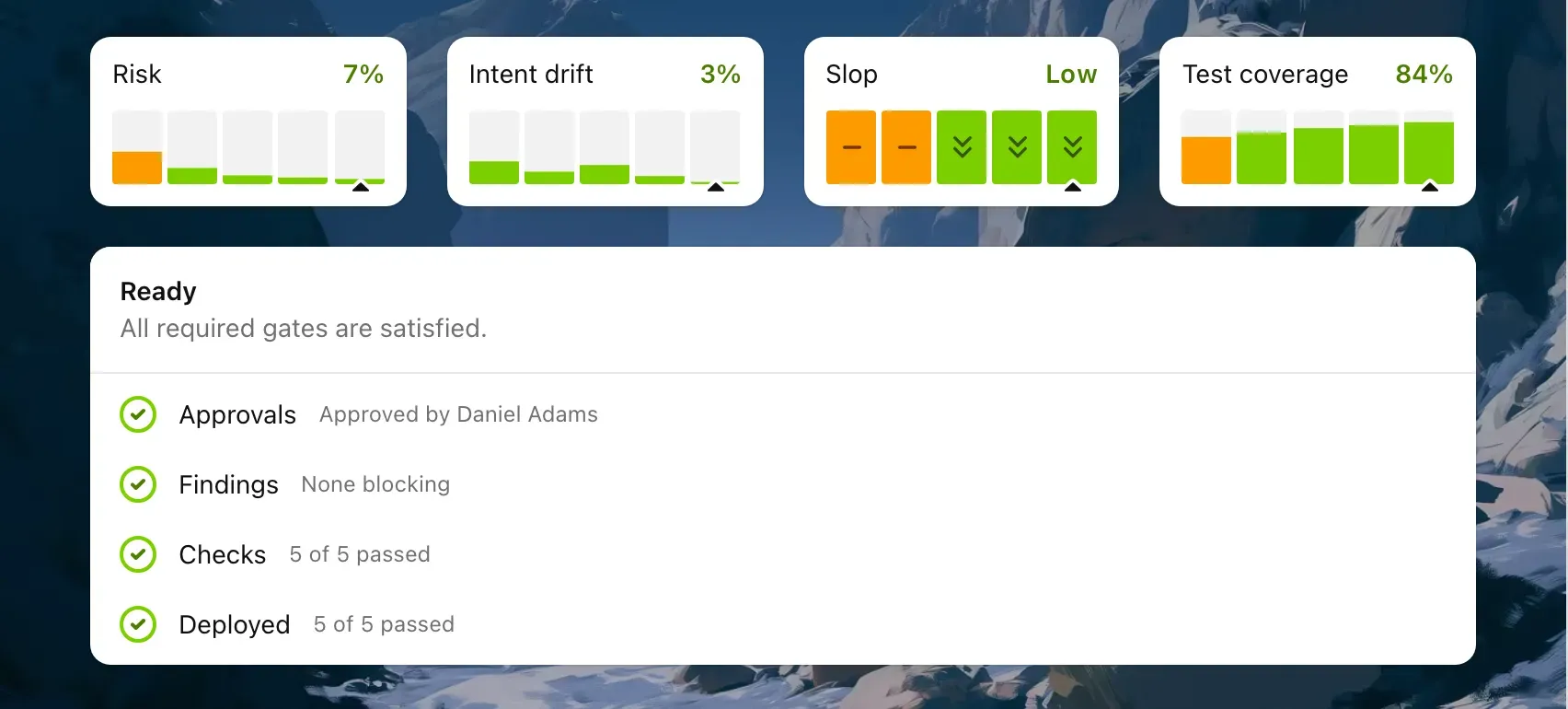
Eval scores with their latest runs, and the gates below them. Source: entire.com.
This is, in our view, the genuinely new idea: review is no longer a diff that a human reads, but an intent that converges until independent judges agree. For each eval you see the last five runs, so whether a score settles down. Gates, the conditions for a merge, require among other things human approval and passing CI. (A side note: in real figure skating the highest and lowest marks are thrown out, because judges sometimes get it wrong. Whether Entire does anything like that, we could not find.)
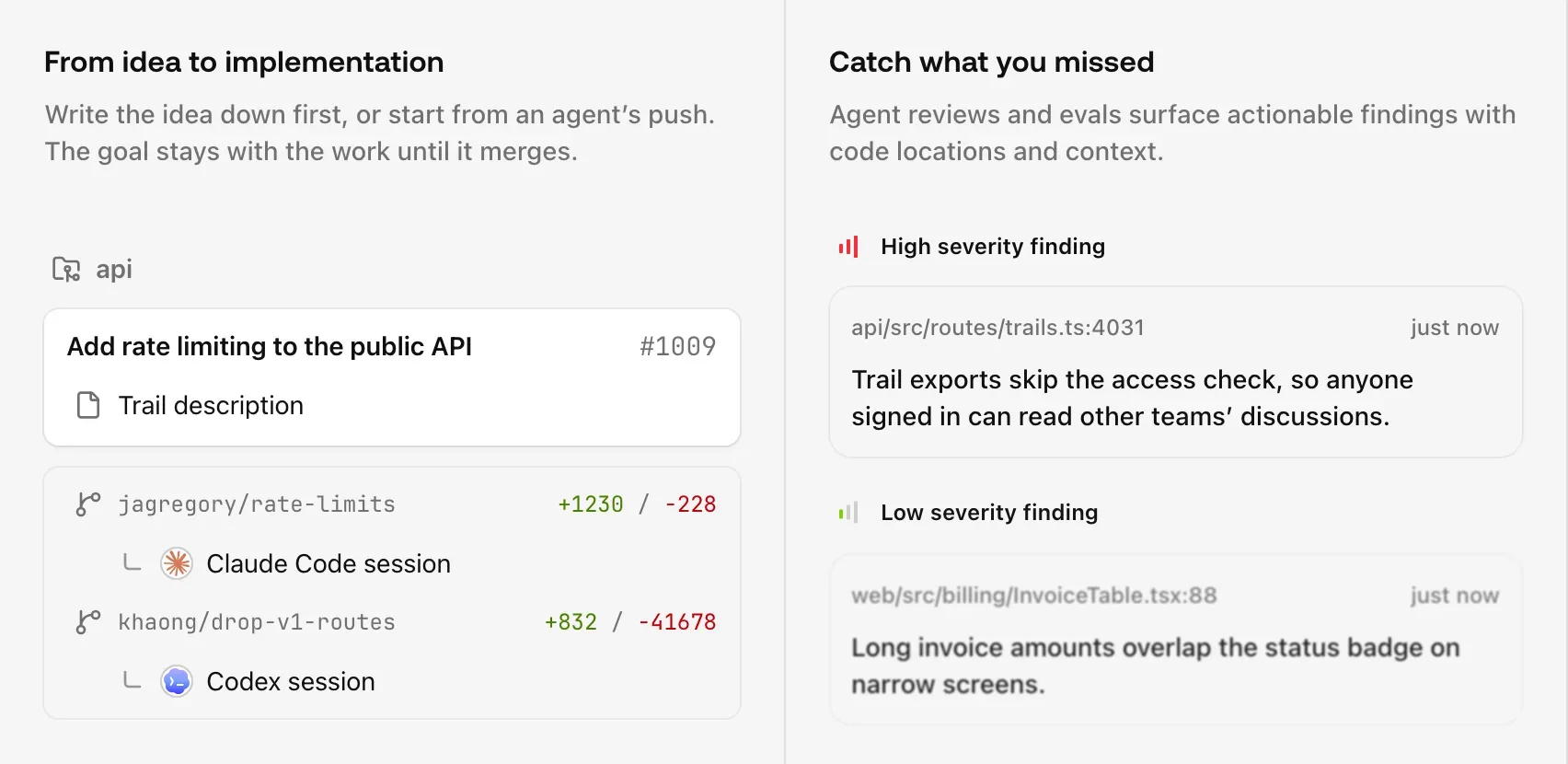
A Trail that bundles two branches and two agent sessions, with findings by severity. Source: entire.com.
Can't you just build this in GitLab or GitHub?
Mostly, yes. A CI job that runs a review agent on every push and reports the score back as a status check is an afternoon's work. Approval rules and branch protection enforce human approval, and a merge train or merge queue does the rest. Harder to rebuild is what sits underneath: a persistent object for the intent, work that belongs together across repositories, and for every commit the agent session and prompt it came from. Whether that is enough against two players with millions of users, we would not dare predict.
The speed claim is the weakest part
Entire says pushes are up to 89 times faster than on GitHub, measured with forgemark, a benchmark it wrote itself. For most teams, though, pushing is not the bottleneck. A push is done in seconds; the pipeline and the review take hours, and sometimes everything waits for that one colleague who is in workshops until Thursday (see also AI Makes Code Cheap. Your Organization Is Still Expensive). And if you stay with GitHub through a mirror, your pushes still go through GitHub, according to the launch post.
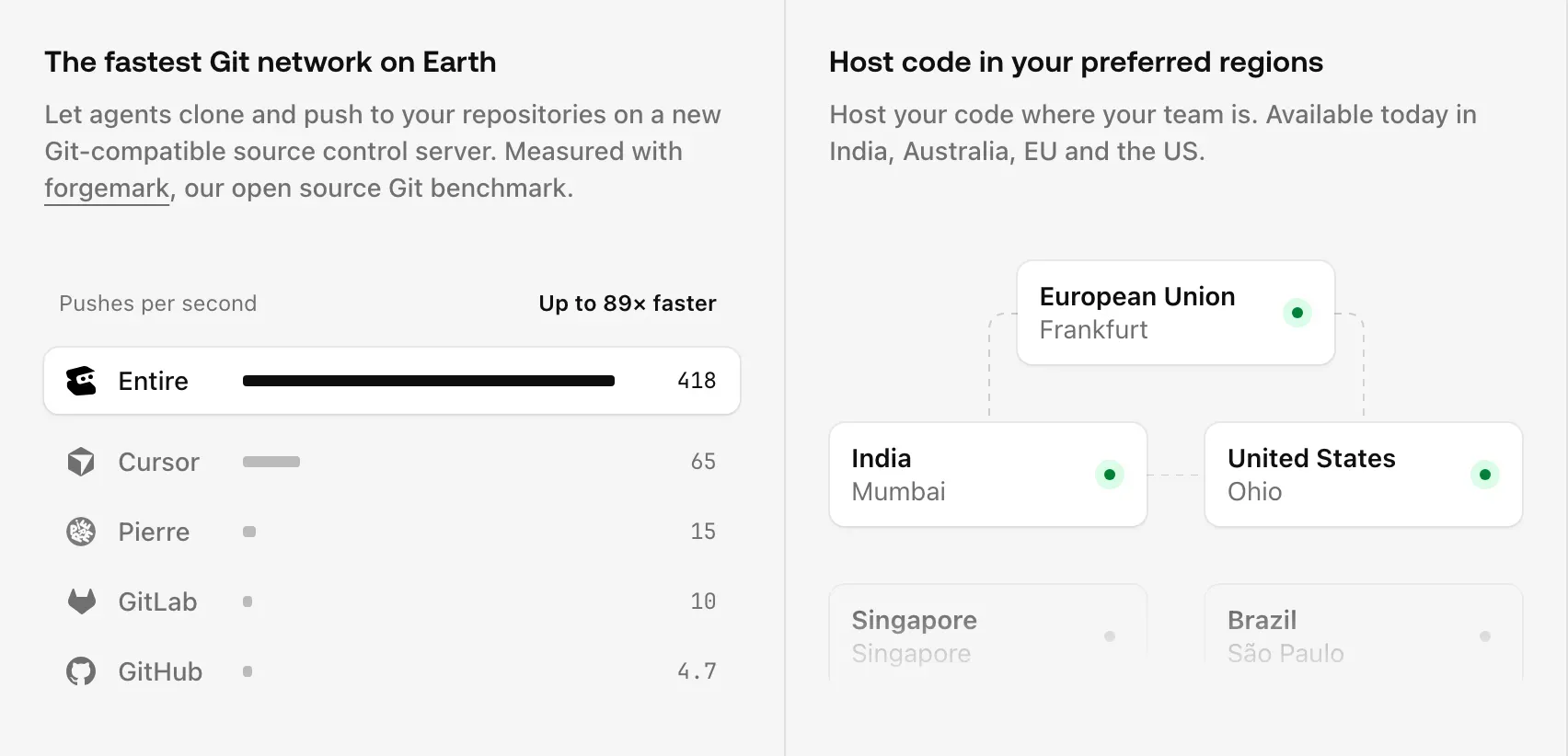
Entire's own forgemark measurement (GitLab 10, GitHub 4.7 pushes per second) and the hosting regions. Source: entire.com.
Data residency is the more practical argument: the EU (Frankfurt) was there from launch. If you work under the GDPR or with regulated clients, "our code is in Frankfurt" does more in a tender than pushing 89 times faster.
Who judges the judges?
The biggest risk, in our view, is Goodhart's law: once a measure becomes a target, it stops being a good measure. An agent that keeps going until the LLM judge (a language model acting as assessor) turns green is optimising against the verdict of another model, possibly with the same blind spots. Five stable runs then mostly prove that the panel agrees with itself.
So the human moves from reading diffs to designing and checking evals. And next to a judge score you measure outcomes, such as the change failure rate (how often a change goes wrong in production). Google's DORA research from 2024 saw delivery stability fall by 7.2% for every 25% more AI use.
Revolution, evolution or a bet?
All three. In review philosophy Entire is a revolution, technologically an evolution, and the hosting is a bet that mainly pays off if you have a fleet of agents pushing all day. For most teams the question is rather what AI does to their change failure rate. In Agile Analytics, our own platform, we therefore judge AI work on outcomes, not on the number of generated lines.
Want to try the Trail pattern without migrating? For one week, have a review agent run on every push and set its score as a status check, keep a few evals as config in the repo, store the last five runs and keep human approval mandatory. We are starting a proof of concept with an agentic development environment ourselves, and we will write up what comes out of it. If you want to talk through AI in your development process in the meantime, an exploratory conversation is free.

The Agent Writes It. Who Reviews It?
AI raises your throughput and lowers your certainty. We help teams stay fast without losing control.
AI engineering
Use AI where it genuinely helps, with accountability staying with people.
Read more:

In 1988 a student took down a tenth of the internet. What did we do next?
In November 1988 a student at Cornell wrote a small program to count how many computers were on the internet. A bug took...

Can Google win the AI race by going Open Source? (making the 10bln OpenAI investment worthless)
A leaked document from an anonymous Google employee has sparked discussions about the impact of open-source AI projects ...

"AI won't take your job, someone using AI will." But which someone?
As a programmer you won't lose your job to AI, but to a programmer who does use AI. I agree. Only by now everyone has a ...

OpenAI's AI agents broke into another company. So why are we calling it a conspiracy?
OpenAI's AI agents broke into Hugging Face, another AI company, this summer. Dwarkesh Patel called it an AI civilisation...

A $200 AI subscription delivers $14,000 of compute. But does the maths hold up?
A $200 ChatGPT Pro subscription supposedly delivers $14,000 a month of compute. That is how the screenshot goes round. I...

My AI Agent Works Through the Night. It Just Can't Decide Anything.
Since August, an agent runs every weekday at half past seven, reads our open merge requests and forms an opinion on each...